I always remember standing in Stockton Parish Church Gardens on August 5th 2014. A year long project was coming to an end and I was leading a closing event to conclude ‘1245 Sunflowers‘. It had been an emotional and deeply impactful year long commemoration remembering the 1245 Stockton soldiers who died in World War I and I was surrounded by thousands of cut down sunflowers that had been grown by our community – and across the world. It had been an idea conceived by my brother who noted that the Sunflower was a fitting Metaphor to reflect of the LIFE of person – not denigrating the more tradition symbolism of the remembrance poppy which was more about the death – the end of life. We turned the concept into a community project distributing sunflower seeds and a simple name card representing a fallen soldier because it seemed more fitting to remember that person as a life rather than just a name. We asked people to reflect upon – or better still research the life of the soldier they were growing a sunflower for – remembering their life – who they were and in doing so, reflecting on who they could have been if that ‘war to end wars’ had never happened.
To my amazement, from 9am on 4th August flower after flower arrived into our Garden of remembrance – accompanied by notes, photographs and details of the soldier they represented. Over 1000 life stories were collected and lovingly recorded by my brother here… http://www.1245sunflowers.org
The project was due to end with that vigil but, as the sun set and I observed the thousands of wilting sunflowers and what they represented I – rather publicly declared that, as we had remembered the community of 100 years ago – men we had never met or previously even heard of – their legacy should be one where we stopped forgetting – or choosing to forget the people we live amongst today.
I remember being particularly drawn to one single red sunflower amongst a canvass of yellow. The same ‘family’ of flowers – but different. It inspired my follow on project – One Red Sunflower in which I led communities on walks across the Borough of Stockton On Tees – walking with – and getting to know people they may not otherwise have met: those in recovery; those living with mental illness; ex-offenders; young carers; people seeking asylum. Each day the walks grew and we were joined by more and more residents for the last mile of each of the walks, finally singing and eating together – and just ‘being’ a community. Follow on projects included Edelweiss, (who knew it was the alpine sunflower) – a family picnic for 2000 people created by and remembering young people in care and the service they were supported by – created as the result of World War I. Isolation and bereavement was the next theme followed by a walk to Belgium and France to remember George Hunter – a young Stockton dad shot at dawn despite being documented as having a mental health condition which restricted his short term memory – our Sunflower number 1246. Finally we created a November light installation of Sunflowers to mark the end of our 5 year commemoration, lighting up a disused church with flowers made from 50,000 discarded plastic bottles, infused with ink and constructed by the biggest community we somehow forget are human beings – the local prison. We remembered those 1246 soldiers each year but the real legacy came in the way we came together with kindness, compassion and a little more empathy than any of us maybe realised we possessed at the start.
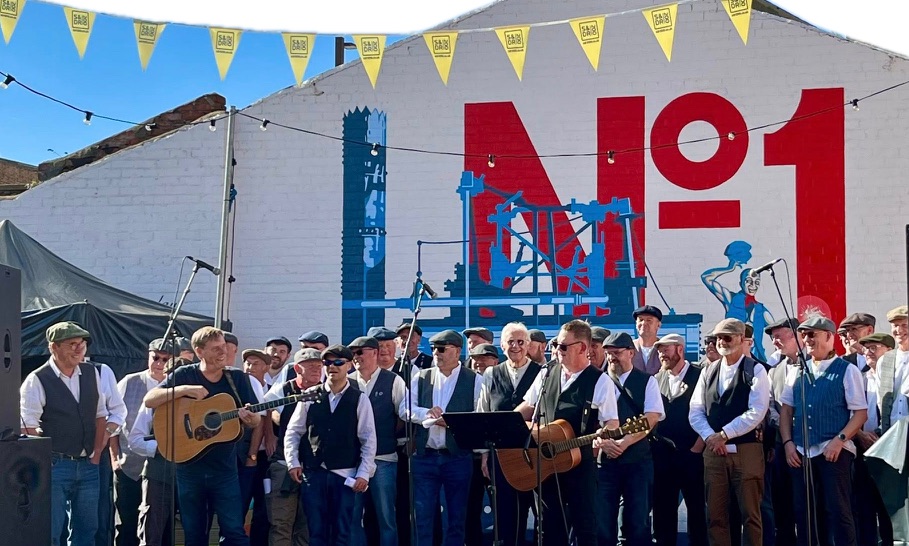
I’m writing this on a train on Monday, 29th November. For many that is a fairly unremarkable and everyday occurrence but today has extra resonance for me after spending the past two days+ with Infant Hercules, my choir for men singing to commemorate 200 years of the Passenger Railways – our ancestors pioneering and likely laying the tracks for them in Stockton & Darlington. I’d thought that this albeit important feat of engineering might leave me cold – I’ve never been that interested in Locomotion No 1 or the consequent advent of Steam Trains etc etc… but something struck a chord with my own strumming as we welcomed the replica of that first engine in Darlington Station at midnight on Saturday night. I was suddenly moved – almost to tears remembering that our great great grandparents – many of whom never lived to see the first journey quite literally connected the world in ways that had never been dreamed of. Their labours – and their skills bridged communities across countries and beyond. That, in itself should be remembered – but as I sang the words of ‘Navigator’ penned by the late great Shane MacGowan, I was reminded that those heroes now revered – the Navvy Pioneers were the rejected and condemned of their day:
‘The Canals and the Bridges, the embankments and cuts. They blasted and dug with their sweat and their guts. They never drank water, but whiskey by pints. And their shanty towns rang with their songs and their fights’.
The words resonated even more the next day when we sang in Stockton High Street. Stockton – like many towns is finding ways to reinvent itself as shopping habits change. It has its fair share of issues with people who are struggling with addiction and consequent chaotic and often socially unacceptable behaviour. They are blamed for ruining the town – for fighting, drinking, drug taking – they are condemned, vilified and labelled ‘bag heads’ and worse by social media commentators.
Ironically we sang Navigator on ‘Bishop Street Car Park’ – or ‘The 1825’ event space for the day… and I couldn’t help but note that we were singing on the site of the ‘slum shanty town’ area of 200 years ago – its residents condemned then – but remembered as those brave pioneers today.
I guess what I am saying is that the S&DR200 experience started as a historical act of commemoration but has inspired me to double up my efforts to use it as an illustration – a reminder that we should all be looking at ways to connect – and to help people get back on track – and to remember and value every person we meet today – not as a character in the chapter of a history book when they – and we have caught our final train home.
 Blind Tiger
Leave a comment